


Maurice Jansen
Erasmus University Rotterdam
Introduction
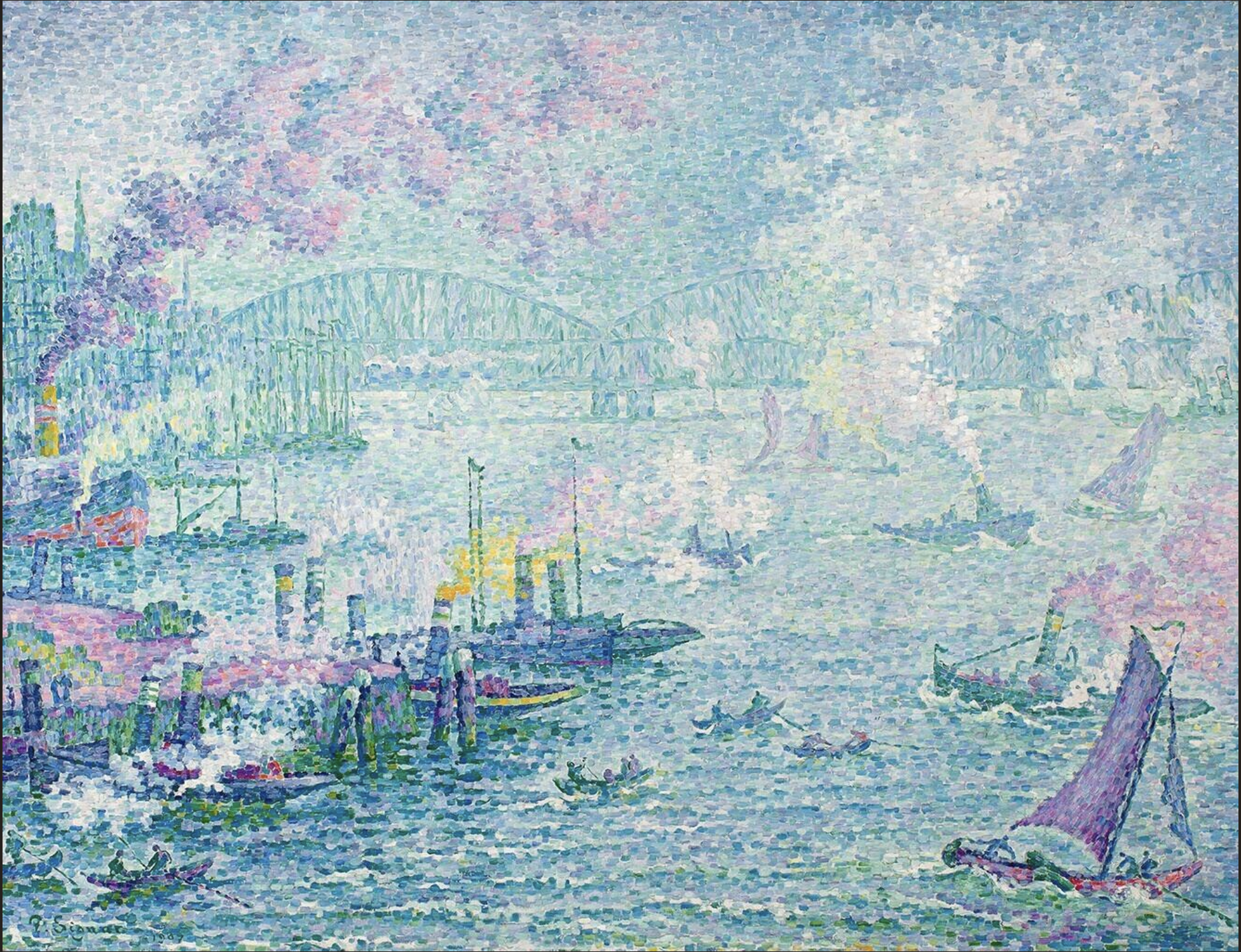
Sometimes history repeats itself—this time for the better, because it marks the return of Paul Signac to Rotterdam. From 24 October 2026 to 28 February 2027, his paintings and those of his friends are on display at Kunsthal Rotterdam. Like me, many will have seen his painting Le Port de Rotterdam when it was shown during the Maritime Masterpieces exhibition at the Maritime Museum Rotterdam, or earlier at Museum Boijmans Van Beuningen. If you haven't, now is your chance at the Signac: Symphony of Colours exhibition at the Kunsthal.
What makes this painting a masterpiece for Rotterdam and why should the people of Rotterdam take Signac to their hearts, as I have?
A neo-impressionist drawn to water, sailing, and ships
Born in 1863, Signac was part of the avant-garde of modern art. As a neo-impressionist, alongside Seurat and Van Rysselberghe, he bridged generations of avant-garde painters, from Monet and Caillebotte to Van Gogh and, later, Van Dongen and Matisse. He maintained many close friendships, as his extensive correspondence shows. His best friend was Henri-Edmond Cross, and he also admired Monet. He even wrote a book about his great role model, Johan Barthold Jongkind, the early Dutch impressionist.
What connected Signac to Rotterdam was his passion for water, sailing, and ships. This combination took him to countless port towns in Europe, from Rotterdam to Constantinople, now Istanbul. On the recommendation of his close-knit artist community, which extended from Paris along the French coast and via Brussels to the Netherlands, Signac visited Rotterdam twice. In 1896 he came with Van Rysselberghe, whom he knew from the circle around Georges Seurat. With Seurat, Signac had perfected pointillism, and after Seurat's untimely death in 1891 he remained loyal to it, or rather to divisionism, the broader approach of which pointillism is one form. This style requires a special technique: not mixing the colours on the palette, but placing them side by side on the canvas, so that they appear to blend. The same method is used in the painting Le Port de Rotterdam, which he made after his visit in 1906. It is quite possible that Signac returned to Rotterdam in spring, from April to early May, to see Kees van Dongen. Van Dongen was back in Rotterdam that same spring, in May and June, for his solo exhibition at the Rotterdamsche Kunstkring. Whatever the occasion, these artists moved in the same circles and influenced one another. A year later, Maximilien Luce—a friend of both painters—would travel to Rotterdam to see the dredging of the Waalhaven with his own eyes.
A ballet of boats and smoke
Looking out over the River Maas from his hotel on the Willemsplein, Signac was deeply impressed by the eternal "ballet of boats and smoke", as he put it himself. He was overwhelmed by the bustle and had to go to great lengths to capture the dynamics of the northern light, the waves, the steam, and the fog, yet he succeeded like no one else. Signac made twelve watercolours on the spot, a medium that allowed him to quickly capture his impressions in soft, pastel tones that blend gently into one another. The watercolours and the now-famous painting Le Port de Rotterdam, which he made in Paris in 1907—and which has since graced many a book cover—were exhibited that same year in the Galerie Bernheim-Jeune, where Rotterdam-born Van Dongen was also exhibiting his work at the time.
Signac’s fellow artists were deeply impressed:
His friend Henri-Edmond Cross wrote: "Soft mauve and green harmonies, inspired by boats and smoke mixing with the clouds, with the Rotterdam bridge in the background, have been wonderfully realized. It's full of movement and in my opinion quite innovative". Georges Lecomte was another admirer. He wrote: "The port of Volendam and the port of Rotterdam, with their fine shades of grey and their subtle blending of grey and smoke, prove that M. Paul Signac knows how to reproduce the cold light of the North as well as the cheerful splendour of the Midi with equal success". Another critic felt that the painting resembled Claude Monet's famous views of the Thames.
From Paris back to Rotterdam
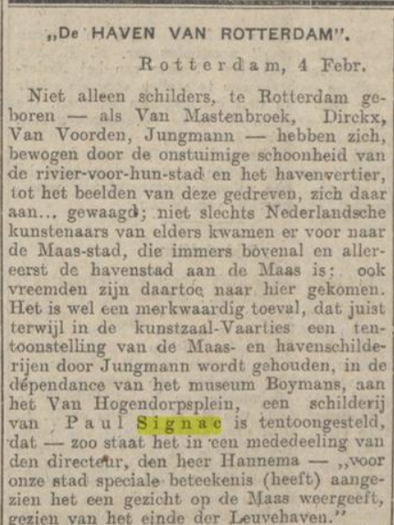
How did the painting make its way from Paris back to Rotterdam? Largely thanks to Dirk Hannema, the director of Museum Boijmans at the time. After a brief mention on 2 February 1925, the Algemeen Handelsblad wrote three days later, on 5 February, of a "remarkable coincidence that at the same time as the exhibition of Maas and harbour paintings by the local artist Maarten Jungmann, a painting by Paul Signac hangs a little further on in the annex of Boijmans on the Hogendorpsplein".
It is highly likely that Dirk Hannema, director of Boijmans at the age of twenty-six, came across the painting in Paris at one of the exhibitions. He had a gift for finding such works—exactly what the industrialists, shipowners, and bankers of the time needed to build their private collections. As a museum director, he maintained close contacts with the Parisian world, the very heart of the Années Folles (the “Crazy Years”), where the avant-garde lived freely. Kees van Dongen was causing a furore in Paris and exhibited at the leading galleries of the day, such as Galerie Bernheim-Jeune and those of the art dealer Paul Durand-Ruel. To establish the exact provenance, however, we would need to dig into the archives.
In the Algemeen Handelsblad of 5 February 1925, we read that Hannema spoke of the "special significance for the city". He was right. Signac's painting captured a time when the port city had made its so-called leap to the south bank of the Maas, had dredged the Rijnhaven and Maashaven, and was now dredging the Waalhaven. Seeking out progress was part of avant-garde life. That is why the painting has been linked to Rotterdam ever since.
Curiously, the Algemeen Handelsblad refers to a temporary loan. That “temporary” arrangement lasted until 1952, when the Boijmans Van Beuningen Foundation was able to officially acquire the painting. The painting and the city have been inseparable ever since.
As Signac himself put it:
“I am struggling against the Maas. It is a perpetual ballet of boats and smoke. And the effects change at every moment.” And then, with a sigh: “It isn’t painting, it’s an indictment.”
A ballet, but also an indictment. Artists know what a struggle it can be to combine paint and colour in such a way that not only the image but also their own emotional state comes through. Of all his paintings, this may well be the one he struggled with most. That makes it all the more fitting for Rotterdam. His struggle with paint, the colours, the water, the elements, and the clouds of industrial steam makes the painting stronger. Stronger through Struggle, as Rotterdam’s motto says!
About the exhibition
Signac, symphony of colours is on at the Kunsthal Rotterdam from 24 October 2026 until 28 February 2027. The exhibition offers an impressive overview of Paul Signac (1863-1935), the master of neo-impressionism, and follows his development through lively harbour scenes, colourful landscapes, and carefully composed portraits. Among the highlights are the sun-drenched Le port au soleil couchant, Opus 236 (1892) and Le port de Rotterdam (1907).
Acknowledgments
Original text in Dutch, then translated to English by the author. This blog post has been written in the context of discussions in the LDE PortCityFutures research community. It reflects the evolving thoughts of the author and expresses the discussions between researchers on the socio-economic, spatial and cultural questions surrounding port city relationships. This blog was edited by the PortCityFutures editorial team: Eliane Schmid.
References
Algemeen Handelsblad. (1925, February 5). p. 9. Delpher, Royal Library, The Hague.
Ferretti-Bocquillon, M., Distel, A., Leighton, J., & Stein, S. A. (2001). Signac, 1863–1935 [Exhibition catalogue]. The Metropolitan Museum of Art; Yale University Press.
Hopmans, A. (2010). All eyes on Kees van Dongen [Exhibition catalogue]. Museum Boijmans Van Beuningen.