


Koen Feenstra and Floris Catijn
Erasmus University Rotterdam
In March 2020, PortCityFutures launched its blog as a platform where both members and guests could publish and share new insights on the study of port city territories. Through short articles, opinion pieces, and responses to current events, the blog was envisioned as a space where researchers from different disciplines could come together and contribute to the foundation of an emerging research field. Six years later, the series has featured more than 200 individual blog posts by over 180 different authors.
To mark the occasion, the editorial team presents a two-part reflection on the six years of the PortCityFutures Blog, looking back on how the platform has developed since its launch. In this opening piece, we look at data on the blog's topics, authors, and formats to better understand its development over time. We also draw on interviews with some of the blog’s most frequent contributors, who reflected on their experiences and shared their views on the future of the blog. In part two, we dive into the behind-the-scenes process of editing with an interview with the blog editors.
PCF Wrapped
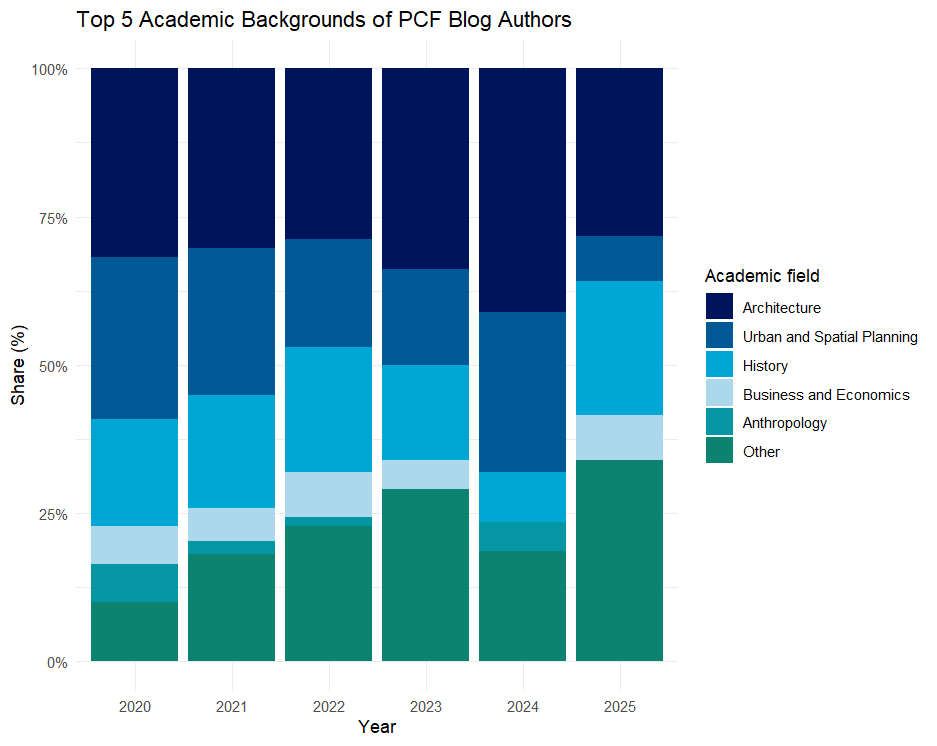
Looking at the disciplinary backgrounds of PortCityFutures blog authors between 2020 and 2025, five academic disciplines, architecture, urban and spatial planning, history, business and economics, and anthropology, stood out from the start, reflecting the founding fields of the Leiden-Delft-Erasmus partnership. While in 2020 architecture and urban and spatial planning together accounted for over half of all contributions, this share gradually declined to around one third by 2025, as authors from a wider range of disciplines, including area studies, political science, sociology, and international relations, diversified the initiative. Although the founding disciplines remain the blog’s disciplinary anchors, we see a trend towards greater multidisciplinarity.
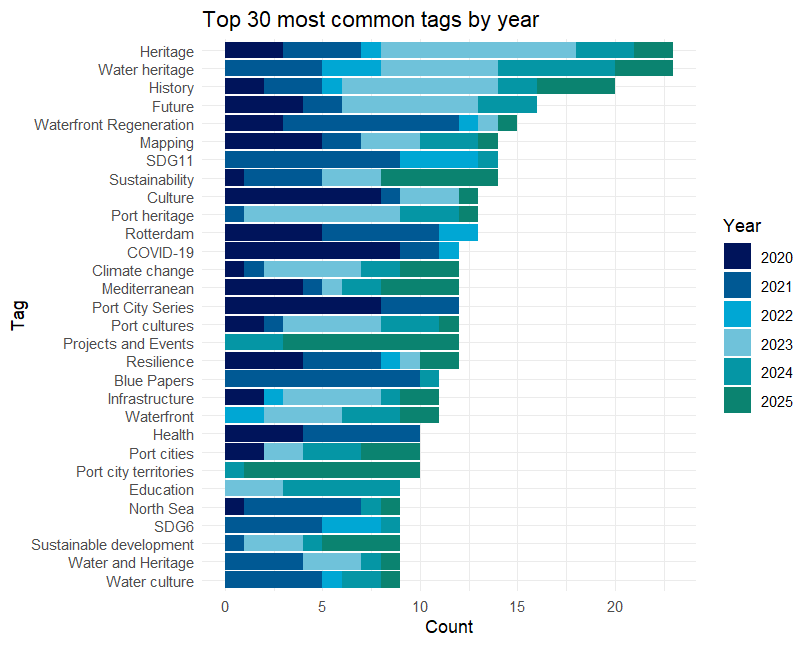
Analysing the tags assigned to each blog post makes it possible to identify trends over time, such as which topics have disappeared, which have emerged, and which have remained consistent. Figure 2 shows that the topics of heritage, water heritage, and history remain consistently dominant throughout the years. Some tags were prominent for a specific period but disappeared over time. For example, Covid-19 appeared during the pandemic but faded with it, while geographical tags such as Rotterdam were phased out following the introduction of the Blog Map. At the same time, tags like sustainable development, sustainability and climate change show an increase in recent years, indicating a growing focus on the role of environmental issues.
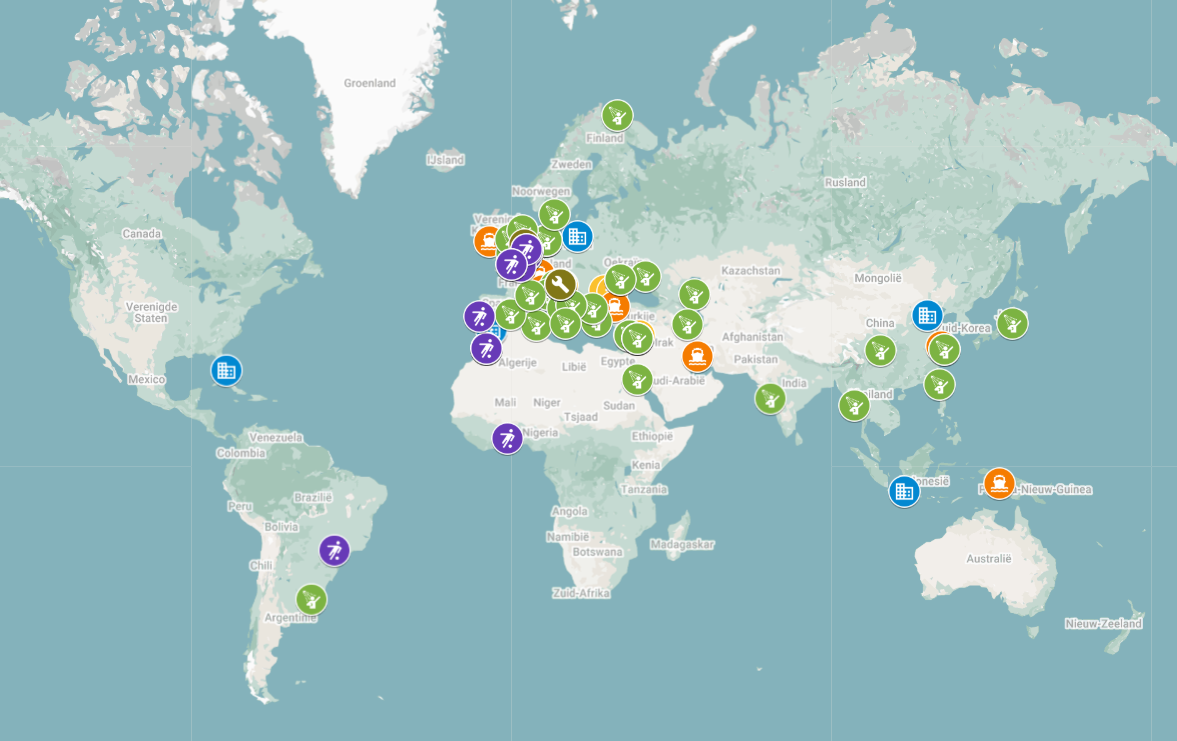
In 2024, the blog introduced an interactive map showing the specific locations written about in each contribution. The same year, PortCityFutures also introduced thematic research groups to organise its articles, to connect theoretical, methodological and case-study approaches to designated grand challenges that port cities face.
The map makes a geographical pattern visible. A majority of the articles are concentrated in Europe and the Mediterranean, and when zoomed in, a particularly high number focus on the port city of Rotterdam. This emphasis on Rotterdam reflects the early focus of the PortCityFutures network. As the network broadened and as the blog became more interdisciplinary and diverse, so too did the locations. There is still work to be done, as the map lacks adequate coverage of North and South America, Sub-Saharan Africa, and Australia.
Contributor Perspectives on the Blog’s Evolution
We invited several of the blog’s most frequent contributors to reflect on their contributions and experiences with the PCF blog, and to share what they see as its most distinguishing qualities and its future. Among them, co-founding team lead Carola Hein offers a behind-the-scenes perspective on how the blog came about, sharing insights that rarely appear in the blog posts themselves. Taken together, these interviews highlight several recurring themes that speak to the blog’s accessibility, interdisciplinarity, and potential for fostering debate.
Looking back, Carola described the project’s earliest development through the first series of blog posts: “The very first blogs were contributions from the core group, notably on the idea of resilience: I outlined some of the questions that were at the heart of our shared interests, notably the theme of port city resilience (Port City Resilience: (Re-)Connecting Spaces, Institutions and Culture). Andrew Littlejohn expanded on it, discussing Are Cities, Ports, and Port Cities Systems? From Optimising to Co-Creating Resilience. Sabine Luning explored Port City Culture - Culture(s) and Cultural Practices. Hilde Sennema and Yvonne van Mil respectively added their thoughts on Experience Port City Cultures from your couch, and New recommendations from the Port City Futures Team and Port City Music on Spotify. Meanwhile, Amanda Brandellero and Maurice Jansen explored the Making of the next port city of Rotterdam. Sarah E. Hinman's contribution on Measuring health in port cities caught the eye of the World Health Organisation (WHO) for their research on port cities and health. Many more articles followed, including ones from close friends and students of PortCityFutures’ MOOCs and courses.”
“My entries in the blog anchored how I wanted my research to develop. So in a way it works as a family photo album”
-Francesca Savoldi
These earliest blog posts illustrate how the blog developed as a platform for a wide range of ideas, voices, and topics. According to the interviewees, it is this accessibility and breadth that distinguishes the blog. As Carola Hein described it, the blog is a platform that “provides an easy publication opportunity for researchers and practitioners of all ages and backgrounds”, while offering a space to share “new ideas, to initiate discussions and to document new findings, including from education”. Hence, the blog was conceived as a response to the limitations of traditional academic publishing. It offered a faster and more flexible way to share ideas and build visibility for the emerging field of port city studies. This openness, combined with the diversity of topics it brings together, also creates space for researchers at different stages of their careers to refine their ideas. For Francesca Savoldi, this role was particularly important, as she described the blog as an anchor for her academic development, akin to a “family album” that captured the evolution of her research over time.
“Over the past few years, I have published several blog posts on the PCF website. I see it as a nice way to share new insights, ideas or projects with colleagues in an accessible manner, or to explore specific themes.”
-Yvonne van Mil
In response to the question of how they would like to see the PortCityFutures blog evolve over the next six years, our interviewees reflected on the role of interaction and debate within the platform. They noted that, while the blog successfully gathers a wide range of contributions, interaction between authors and readers still remains rather limited. They expressed a common desire for the blog to evolve into a space that fosters more dialogue. As Francesca Savoldi put it, “Entries do not generate debate or exchange and therefore remain ‘sterile’,” pointing to the need for a more active space of debate across members and disciplines, through which the platform could become more generative. Similarly, Yvonne van Mil noted that “It would be nice if the blogs could lead to conversations or discussions within the field”, suggesting “an option to comment, as with a LinkedIn post.”
“The PCF blog provides an easy publication opportunity for researchers and practitioners of all ages and backgrounds. It is a platform to test new ideas, to initiate discussions and to document new findings, including from education.”
- Carola Hein
This ambition aligns with the vision articulated by Carola Hein, who emphasizes the blog’s potential to continue to grow and expand internationally into an “ongoing platform for researchers and professionals to add their voice to the exploration of port city territories as authors and editors.” Ideally, the blog “continues to serve as a launch pad for new initiatives that promote sustainability in port city territories and water heritage, and as a tool for young researchers to find and refine their voice.”
Reflections
Six years of posts, authors, and tags show that the blog has broadened across disciplines, topics, and geography. It has developed into an accessible platform that brings together a growing and increasingly interdisciplinary community of researchers and practitioners. The steady expansion in both topics and disciplinary backgrounds also demonstrates its role in shaping the emerging field of port city studies. Meanwhile, our analysis hints at future potential. While the blog has broadened its thematic scope and geographical reach, certain regions remain underrepresented, and interaction between contributors and readers is still limited. The editorial team looks forward to developing and editing emerging topics for PCF in the future.
This blog post is part one of the two-part reflection series on ‘Six years of the PortCityFutures blog’. Click here to read Part 2.
Acknowledgement
This blog post has been written in the context of discussions in the LDE PortCityFutures research community. It reflects the evolving thoughts of the authors and expresses the discussions between researchers on the socio-economic, spatial and cultural questions surrounding port city relationships. We would like to thank Carola Hein, Yvonne van Mil, and Francesca Savoldi for the interviews. This blog post was edited by the PortCityFutures editorial team: Yi Kwan Chan and Nathan Döding.