


Floris Catijn
Erasmus Universiteit Rotterdam
Introduction
Within the broad field of port studies, few topics fascinate me more than the role of ports in state socialism. My interest in this subject was sparked by the 2021 forum Ports in State Socialism, published in the International Journal of Maritime History, which explored how socialist ports functioned and were embedded in international networks during the second half of the twentieth century (Normand & Lemmen, 2021). What makes these ports so fascinating is their unique position within socialist societies. Socialist states generally preferred closed borders, opposed free trade, and were characterised by high levels of political repression. Ports, on the other hand, are hubs that facilitate the exchange of culture, goods, capital, and people. This apparent contradiction raises many questions: how did these ports function within socialist societies? How isolated was the Eastern Bloc actually during the Cold War (Normand & Lemmen, 2021)?
These questions formed the basis of my master's thesis, in which I examined how the establishment of an overseas port in Rostock, Germany, in 1958, contributed to East Germany's societal and diplomatic connections in the Baltic Sea region. My research findings from sources such as city council minutes and planning documents at the Stadtarchiv Rostock, together with my internship at PortCityFutures, led me to look beyond the port’s construction and examine its impact on Rostock's development as a socialist port city. Rather than viewing the port as an isolated infrastructure project, I came to understand it as part of a much larger policy of the East German state aimed at strengthening its presence and influence in the Baltic Sea region. Central to this was Rostock’s rebranding as the German Democratic Republic’s (GDR) new Tor zur Welt, or 'Gateway to the World', deliberately appropriating a slogan long associated with Hamburg (cf. Amenda, 2006). In this blog post, I delve into a chapter of my thesis that analyses how Rostock developed as a socialist port city to fulfil this new role of opening up to the world.
To fully grasp the significance of this transformation, it is important to understand the historical context of the GDR in the 1950s. After its founding in 1949, East Germany entered its first decade in a state of existential crisis. The failure of the United States and the Soviet Union to reach an agreement on Germany's future after the Second World War had left East and West Germany locked in a struggle for legitimacy. Consequently, relations between the two German states continued to deteriorate. Some historians, such as Rainer Karlsch (2013), see the construction of the overseas port as part of a broader East German effort to build its own national economy and gain strategic independence from the West. Michael F. Scholz (1990), focusing specifically on the Baltic Sea Week, places Rostock within the GDR’s broader foreign-policy goals more specifically. The Baltic Sea Week was an annual festival held in Rostock from the year of the port’s founding in 1958 until 1975, during which visitors from across the Baltic Sea region were invited to celebrate cultural exchange under the banner of ‘The Baltic Sea must be a sea of peace’. Scholz shows how the GDR government used this festival to present the country as a peace-loving state and as the only legitimate representative of the German people. In this sense, the port was not only a political and economic instrument, but a vehicle for the diplomatic narrative through which the GDR sought to overcome its isolation.
The Baltic Sea Week
How, then, did this festival make use of and influence the development of Rostock as a socialist port city? Documents related to preparations for the Baltic Sea Week reveal how the city was transformed into a stage on which the state performed its propaganda efforts. They show that the local officials organising the event were keen to present visitors with a carefully curated image of the GDR as a peaceful and modern socialist state. While local and foreign participants took part in sporting events, music performances, and art exhibitions, they were exposed to anti-Western and anti-NATO messaging that portrayed the West German government as fascist, militaristic, and bent on provoking a nuclear war. For example, as visitors made their way across the city from one event to another, they would encounter information stands strategically placed by the local authorities at busy intersections, condemning West German militarism and celebrating Soviet achievements in space exploration (Stadtrat Rostock, 1958).
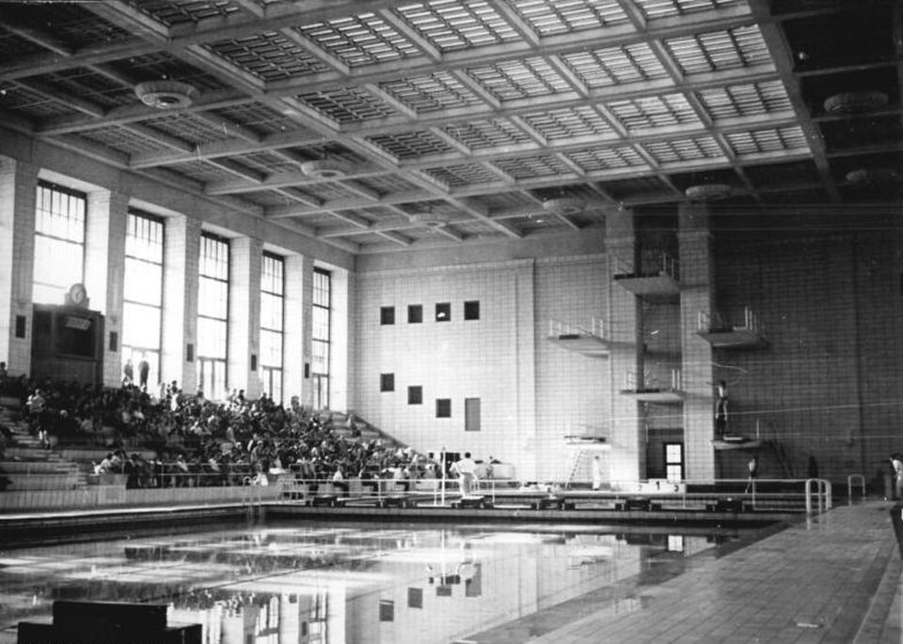
Official documents also reveal how local officials reshaped Rostock’s physical fabric to reinforce this political narrative. Minutes of city council meetings and planning documents show that in preparation for the first Baltic Sea Week in 1958, Rostock underwent a substantial makeover (Stadtrat Rostock, 1958, 1959). These urban improvements served a dual purpose: they provided the infrastructure needed to host international visitors while simultaneously demonstrating to both guests and residents that socialism could provide a modern, attractive, and liveable urban environment. This included the construction of new public facilities, such as sports venues and recreational spaces. Additionally, projects already underway since the 1950s came under increased pressure to be completed. For example, considerable resources were devoted to expanding the Rostock Sportforum (see figure 1), which served as a key venue during the festivities. The East German state also invested in expanding the Rostock zoo as well as the university (Stadtrat Rostock, 1958, 1959). Together, these facilities helped establish Rostock as the GDR's showcase of socialist modernity.

Beautifying the city
Beyond infrastructure, significant effort was further devoted to beautifying the city itself. Local officials paid particular attention to three key areas: one priority was the expansion and improvement of the city’s green spaces (Stadtrat Rostock, 1958; Stadtleitung der SED Rostock, 1958). In the GDR, such amenities were more than mere recreational spaces. They were part of a broader vision for the ideal socialist city and therefore subject to political objectives. Take the East German housing estate of Marzahn, for example, where more than 38,000 trees were planted during its construction. According to Eli Rubin, this was just as much about conquering the natural environment as about shaping the social habits and behaviours of its inhabitants (2016, pp. 56–59). By involving residents in creating these green spaces, as was also the case in Rostock, the GDR’s government officials sought to make citizens active participants in building their socialist utopia. To foreign visitors, these parks projected an image of modernity, as their construction and maintenance required considerable resources and demonstrated the state's ability to provide for its citizens.
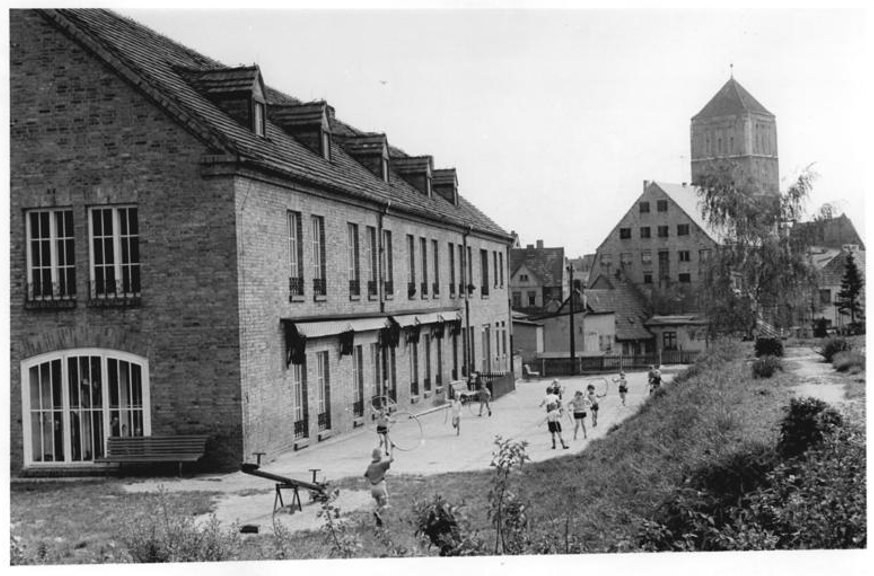
Another focus of the state was on constructing children's playgrounds. Government documents on the Baltic Sea Week, particularly its early iterations, reveal that such amenities were to be constructed in significant numbers across both the historic city centre and the newly developed residential districts (Stadtrat Rostock, 1958; Stadtleitung der SED Rostock, 1958). Throughout Europe and North America, playgrounds were often conceived by planners and designers as spaces that helped shape social relations and urban life. They served as ‘social laboratories’ to educate children, as well as the broader community around them, in the norms of a given political-societal order (Burkhalter, 2023). Much like the green spaces, these playgrounds were also intended to reflect the state's commitment to public welfare, family life, and the improvement of living conditions. Their construction helped establish an image of socialism as a system capable of creating livable, attractive cities, while also shaping the next generation of socialist citizens.

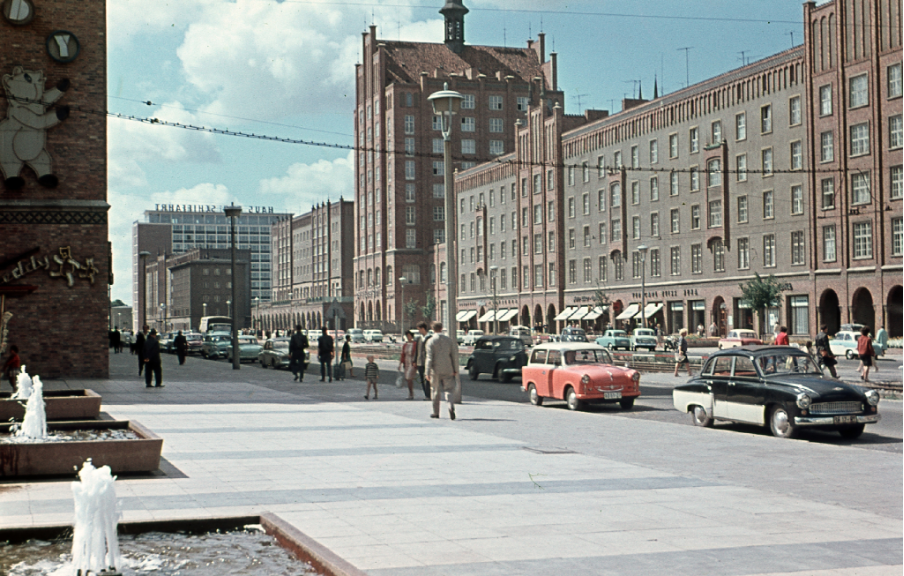
A third area of attention for the municipal government was the renovation of façades in the historic city centre. This effort was carried out systematically, street by street, with the goal of restoring 1,300 façades by 1960 (Stadtrat Rostock, 1958; Stadtleitung der SED Rostock, 1958). On the one hand, this programme can be seen as simply a logical and necessary step in making the city presentable to visitors, as Allied air raids during World War Two had left much of the historic centre in great disrepair (Enss & Knauer, 2022). On the other hand, the restoration of the historic centre served a broader political purpose. As Jörg Kirchner (2015) argues, architecture in the GDR was used to shape collective identity and establish links with a specific version of the past narrated by the state. By appropriating the local Brick Gothic architectural style, the state sought to provide the young GDR with a sense of historical legitimacy and cultural continuity. The restoration of historic façades can therefore be seen as an attempt by the state to project its claim of the GDR's historical legitimacy to both locals and visitors.

Conclusion
Fulfilling its new role as the GDR's Tor zur Welt therefore required both the physical and ideological reshaping of Rostock. As a result, the city became a showcase of the achievements of the socialist society. The case of Rostock shows that socialist port cities were themselves political projects, rather than simply places where ports were located. As such, the city's role as a gateway to the world was never intended to imply unrestricted openness. International exchange remained carefully managed by the East German authorities, as illustrated by the tightly orchestrated and closely monitored Baltic Sea Week. Despite this, my thesis ultimately concludes that although these interactions were carefully planned and monitored by the East German state, they nevertheless created opportunities for genuine exchange across the Iron Curtain, contributing to the restructuring of both societal and diplomatic connections across the Baltic Sea region during the Cold War.
Acknowledgements
I would like to express my sincere gratitude to my thesis supervisor, Annette de Wit, and to Gijs Dreijer, who together led the International Relations and the Sea research workshop in which I wrote my thesis, for their continued support and guidance. I would also like to express my sincere gratitude to the Professor Van Winter Fonds and the Samenwerkende Maritieme Fondsen for their financial support, which made this research possible. This blog post has been written in the context of discussions in the LDE PortCityFutures research community. It reflects the evolving thoughts of the authors and expresses the discussions between researchers on the socio-economic, spatial and cultural questions surrounding port city relationships. This blog was edited by the PortCityFutures editorial team: Yi Kwan Chan and Eliane Schmid.
Primary Sources
Stadtleitung der SED Rostock. (1958). Maßnahmeplan zur Verschönerung der Stadt Rostock
in Vorbereitung der Ostsee-Woche (Beschluss des Büros der SED-Stadtleitung vom
10.1.1958). Stadtarchiv Rostock (2.1.1. 5177).
Stadtrat Rostock. (1958). Maßnahmeplan zur Verschönerung der Stadt Rostock zur
Vorbereitung der Ostseewoche 1958. Stadtarchiv Rostock (2.1.1. 5062).
Stadtrat Rostock. (1959). Plan zur Ausgestaltung der Stadt Rostock während der
Ostseewoche 1959 (Beschluss des Büros der Stadtleitung vom 29. Mai 1959).
Stadtarchiv Rostock (2.1.1. 5178).
Lange Straße, Rostock, (1962). Photograph by an unknown photographer, preserved by
Fortepan. Retrieved from Wikimedia Commons (https://commons.wikimedia.org/
wiki/File:Rostock-Lange_Strasse-1962_(fortepan_44290_unknown).jpg),licensed
under CC BY-SA 3.0.
Link, H. (1966). Rostock, Kindergarten am Beginer Berg [Foto]. Bundesarchiv.
https://commons.wikimedia.org/wiki/File:Bundesarchiv_Bild_183-E0603
-0021-005,_Rostock,_Kindergarten_am_Beginer_Berg.jpg

Löwe. (1957). Rostock, Schwimmhalle Neptun [Photo]. Bundesarchiv.
https://commons.wikimedia.org/wiki/File:Bundesarchiv_Bild_183-46639-0002,_
Rostock,_Schwimmhalle_%22Neptun%22.jpg
Secondary Sources
Amenda, L. (2006). “Welthafenstadt” und “Tor zur Welt”: Selbstdarstellung und
Wahrnehmung der Hafenstadt Hamburg 1900–1970. Deutsches Schiffahrtsarchiv, 29,
137–158.
Burkhalter, G. (2023). The playground project (Dritte, völlig überarbeitete und erweiterte
Auflage). Park Books.
Enss, C. M., & Knauer, B. (2022). Atlas Kriegsschadenskarten Deutschland. Birkhäuser
Verlag. https://doi.org/10.1515/9783035625011
Karlsch, R. (2013). National Socialist autarky projects and the postwar industrial landscape.
In H. Berghoff & U. Balbier (Eds.), The East German economy, 1945–2010: Falling
behind or catching up? (pp. 77–94). Cambridge University Press.
Kirchner, J. (2015). Die Lange Straße in Rostock (1953–58). Heimatschutzstil als eine
Quelle der frühen DDR-Architektur. ICOMOS, 58(4), 66–69.
https://doi.org/10.11588/ih.2013.4.20083
Normand, B. L., & Lemmen, S. (2021). Ports in state socialism, or why the Cold War matters
to maritime history. International Journal Of Maritime History, 33(1), 118–128.
https://doi.org/10.1177/0843871421991176
Rubin, E. (2016). Amnesiopolis: Modernity, Space, and Memory in East Germany. Oxford
University Press. https://doi.org/10.1093/9780198732266.001.0001
Scholz, M. F. (1990). ‘Die Ostsee Muss Ein Meer Der Friedens Sein’ Die Rostocker
Ostseewochen in der Aussenpolitik der DDR (1958-1975) [PhD diss.]. University of
Greifswald.
Stollenwerk, J. A. (2021). Economic necessity and political reality in the GDR: Establishing
an overseas port at Rostock. International Journal Of Maritime History, 33(1),
129–144. https://doi.org/10.1177/0843871421991177
Scholz, M. F. (1990). ‘Die Ostsee Muss Ein Meer Der Friedens Sein’ Die Rostocker
Ostseewochen in der Aussenpolitik der DDR (1958-1975) [PhD diss.]. University of
Greifswald.