


Jiang Feng, School of Architecture, South China University of Technology
Jianing Zhang, School of Architecture, South China University of Technology
Rui Li, Urban Elephant Architects & Planning
Introduction
The daylighting of canals culverted during urbanization processes has emerged as a key strategy for conserving cultural landscapes in China over the past two decades, given its dual significance in enhancing aquatic ecological resilience and safeguarding the integrity of cultural landscapes. In this blog, architectural historian Jiang Feng and architects Jianing Zhang and Rui Li examine how historians and landscape architects in conservation can re-establish the relationship between cultural heritage and contemporary public space by rejuvenating traditional water-related cultural landscapes. These landscapes may also aid sustainable development in the future. The case study of a daylighted canal in a traditional Cantonese water village– Cunxin Canal in Bijiang Village – serves as an example for the Pearl River Delta.
The Emergence, Development, and Decline of Cyun Sam Gaai Canal
Canals have long facilitated the commercial activities across the Pearl River Delta in the late Chinese Empire (ca. 1368-1912). Since 1757, Guangzhou was designated as the sole port for international trading under the ‘Canton System (一口通商)’. The inland waterways connecting Guangzhou and Macao (the international trading post colonized by the Portuguese) served as the only shipping route for foreign merchants as they were required to commute regularly between the two cities by boat. Most of the route depended on inland canals, which offered relatively stable hydrological conditions and supply facilities rather than on the broad, hazardous main streams of the Pearl River. Settlements along these waterways therefore evolved into prosperous market hubs, whose morphogenesis, built heritage, and folk customs were deeply shaped by canals.
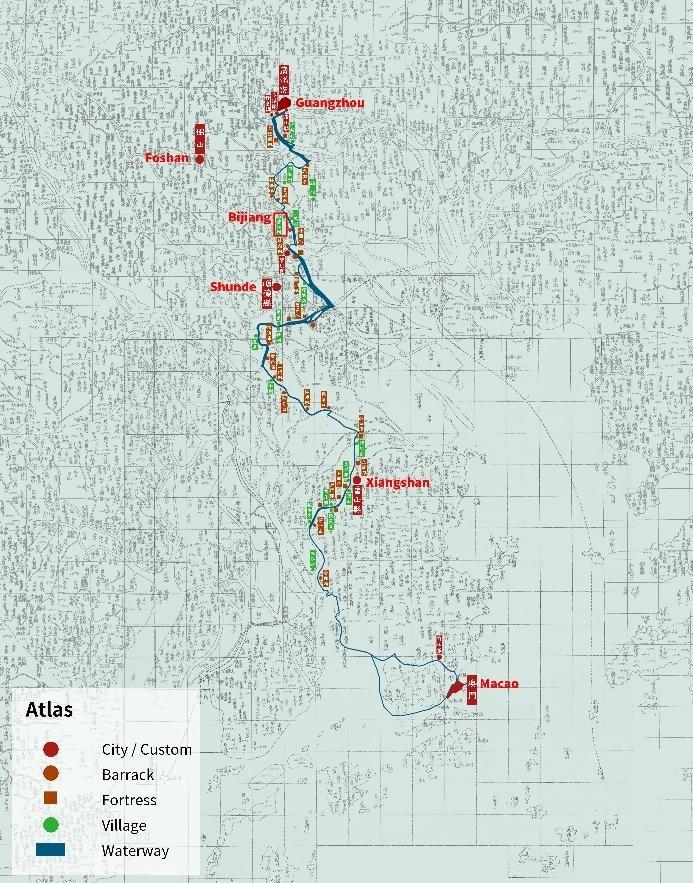
Bijiang represents a typical traditional settlement along the Guangzhou-Macao inland waterway. Founded in the 12th century, its riparian zones had been extensively developed through levee construction and hydraulic governance. Owing to its proximity to the first customs post outside Guangzhou, Bijiang grew into one of the region’s key marketplaces by the 18th century and was connected to the inland waterway via nine village canals. Local markets were situated at canal confluences, while canal-side settlements were home to native clan communities. A prominent example is the Su clan territory along the Cunxin Canal (村心涌, or Cyun Sam Cung in Cantonese, literally means the village center canal). Most of the surviving built heritage from the 18th century, including ancestral halls, mansions, warehouses, arcade streets, altars and shrines, is concentrated along its waterfront, forming Bijiang’s core cultural landscape together with water-associated folk customs – floating flower markets, dragon dances, and waterside ritual worships.
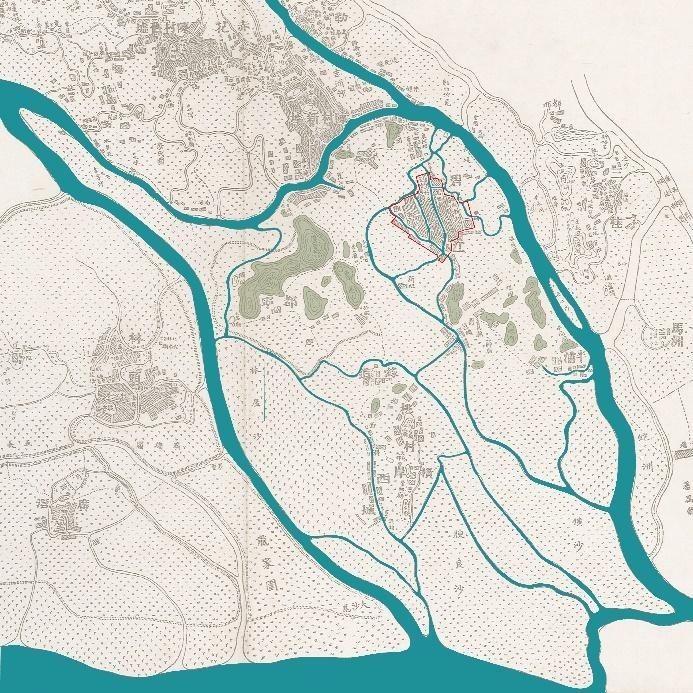
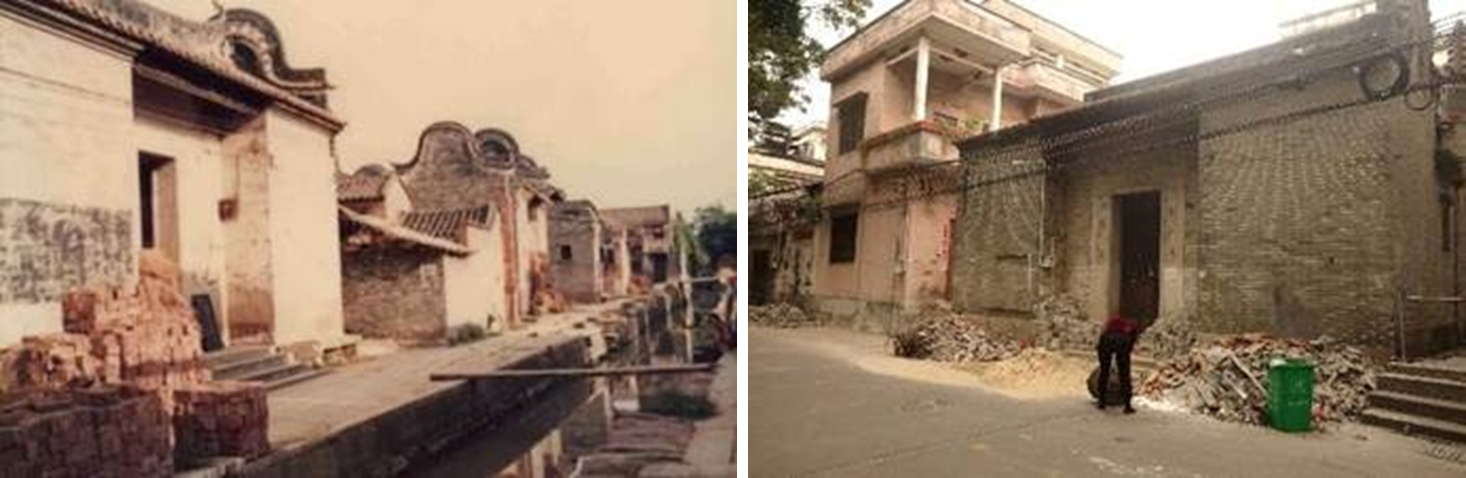
However, since the Chinese reform and opening up in 1978, Bijiang's water-related cultural landscape has come under threat from the rapid urbanization of the Pearl River Delta.Industrial water pollution and the shift from water transport to road transport led to most of Bijiang’s canals being culverted and erased from the maps, so that the continuity of the water-related landscape could no longer be sustained through isolated, small-scale efforts.
Daylighting the Canal
Efforts to daylight the Cunxin Canal began after Bijiang was declared a National Historical and Cultural Village. Scholars, elders of the clans, community governors, and villagers supported the bid by documenting and interpreting the village’s historical characteristics. The involvement of community planners in 2019 advanced consensus-building for canal daylighting through community-based participatory design, with residents’ opinions systematically collected and validated during the feasibility study. In line with the regional strategy of Shunde District to revitalize the city through water governance, the project of Cunxin daylighting was formally approved in 2023, and completed in 2025.
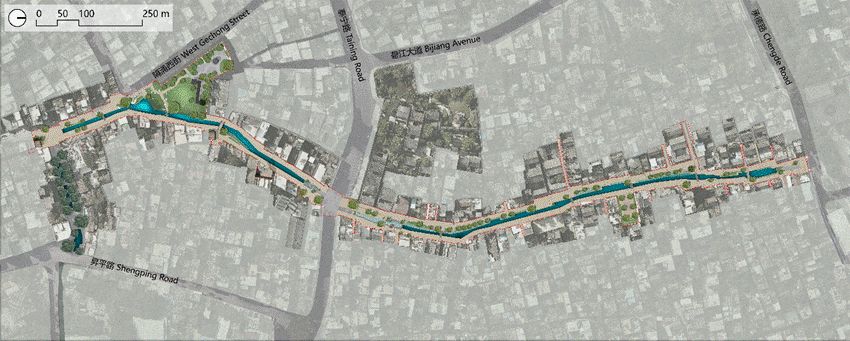
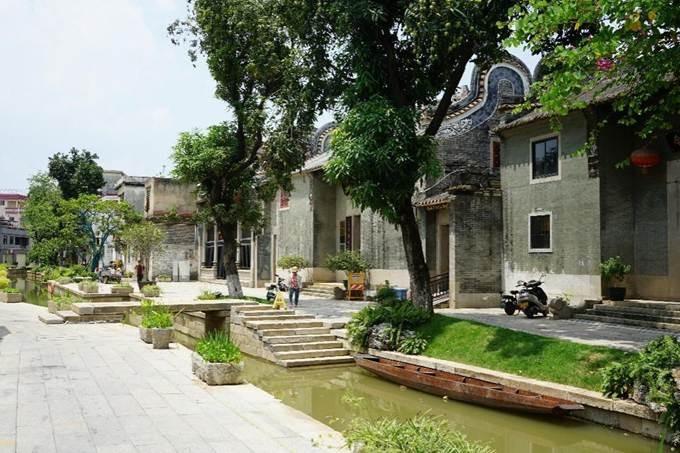
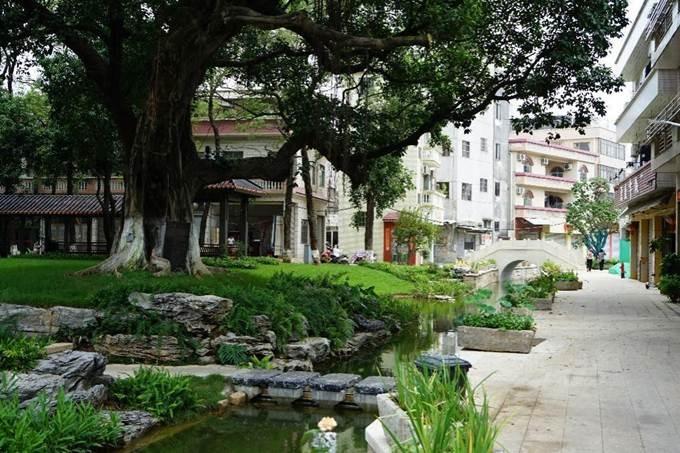
The daylighting of Cunxin Canal was supported by a series of technical interventions, including water pollution remediation, hydrodynamic improvement, upgrading of mechanical, electrical, and plumbing (MEP) systems, reconstruction of hydraulic structures, and construction of ancillary facilities such as parking lots. Through collaboration among heritage conservators, hydraulic engineers, municipal engineers, and landscape architects, the dimensions, water-land border, and form of the canal were designed to reflect its 19th century appearance, thereby restoring the morphological structure of the waterfront public spaces. Diverse cross-sections were adopted for different waterfront sections to re-establish the spatial relationship among the canal, revetments, and adjacent built heritage. Accessible waterfront zones were created by the elaboration of architects and structure engineers to support waterside activities such as fishing and water fetching. The planners of the waterfront redesign consulted traditional poems and oral histories to reconstruct historically significant sites, such as Deyun Bridge, traditional sluices, and waterfront gardens.
The Revival of Waterfront Areas
The daylighting of Cunxin Canal has effectively revitalized Bijiang not only through the recreation of the landscape character of traditional Pearl River Delta water settlements, but also through its reactivation of waterfront public life. The uncovered waterway has reconnected scattered built heritage sites and rejuvenated cultural landscapes. This brought to light the significance of water-related cultural landscape in the village and revived traditional customs such as dragon dances, spring festival ceremonies, and riverside fairs.The canal has also attracted a series of further regeneration projects along its banks, including Deyun-ju restaurant and numerous privately funded studios.
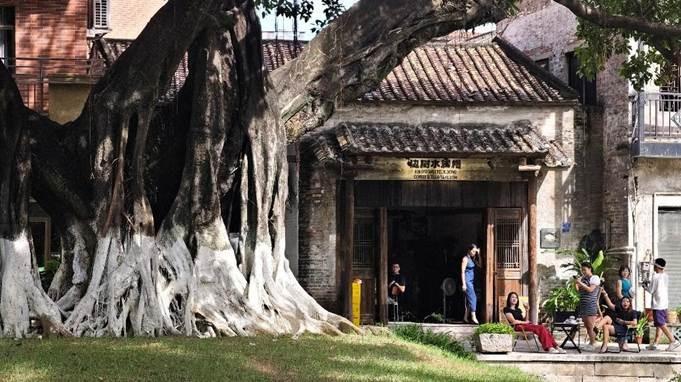
Deyun-ju, located beside a tributary of the Cunxin Canal, has gradually grown from a small eatery into a complex of garden restaurants through the elaborations of a local merchant. Vacant traditional buildings have been progressively rented, renovated and now include courtyards that are integrated within the scenery of the existing canal. The adjacent arcade street alongside the uncovered canal has been transformed into a workshop for the display and training of local craftsmanship and arts. Supported by a local art foundation, artists and historians from Guangzhou have worked together to hold art exhibitions and symposiums on indigenous literature in renovated old houses near Deyun-ju, joining contemporary perspectives with local cultural knowledge. As practitioners of Cantonese cuisines, calligraphy, tea ceremony and carving settled in the area, waterside shops were spontaneously converted into cultural and creative product shops, restaurants, and cafes, attracting large numbers of visitors. These projects, together with heritage sites and cultural venues, have attracted tourists to the canal. To date, the daylighting of the canal has boosted the village’s economic development through the regeneration of its water-related cultural landscape, laying a foundation for further heritage conservation initiatives.

Although the daylighting of the Cunxin Canal has been regarded as a meaningful attempt to rejuvenate Bijiang’s historical landscape, the project has also been accompanied by certain controversies. According to a research report compiled in 2024 by the local research group ‘Situated Practice’, local residents generally hold ambiguous attitudes towards the daylighting project, especially against the backdrop of Bijiang’s declining economic conditions due to the severe contraction of China’s real estate industry. Many residents argued that, rather than implementing the project, the funds would have been better distributed directly to residents, although these funds, in legal terms, could only be used for hydraulic construction projects.
The attitudes of local businesses have demonstrated a more complex transformation. During the initial stage of project implementation, merchants along the canal expressed dissatisfaction with the impact of road closures on their businesses. However, after the completion of the daylighting project, merchants began to proactively invest in transforming their shops into experiential consumption spaces.
Situated Practice summarized these responses as reflecting “the complex reflections of villagers toward the canal’s daylighting and the modernization process”: residents were reluctant to relinquish their immediate economic interests, yet they also held vague expectations and uncertainties regarding Bijiang’s future development. The transformation of Bijiang has therefore unfolded amid tensions between short-term demands and cultural identity.
(Re-)activating the village by (Un)covering canals
The covering and subsequent uncovering of the Cunxin Canal illustrates the pivotal role of canals in the development of Pearl River Delta water villages. Bijiang’s historical prosperity was rooted in its position along the Guangzhou-Macao inland waterway, with canals serving as the primary driving force of its cultural landscape formation. Amid regional modernization, the decline of water transport and worsening water pollution led to the canals’ culverting. Through continuous regeneration efforts by the collaboration of scholars, architects, local administrators and villagers, the daylighting of Cunxin Canal has reintegrated water-related cultural landscapes into the public space system. Although no longer used for trade, the uncovered canal has revived the historical waterfront settlement lifestyle and opened new possibilities for the village’s continued development and reimagining. This (re-)activation process showcases the value of water-related cultural landscapes in contemporary heritage conservation: water embraces the past, sustains the present, and flows toward the future.
Acknowledgments
This blog post has been written in the context of discussions in the LDE PortCityFutures research community. It reflects the evolving thoughts of the authors and expresses the discussions between researchers on the socio-economic, spatial and cultural questions surrounding port city relationships. This project is initiated by the Research Center for Architectural History and Culture at South China University of Technology (Jiang Feng, Min Xiao, Haohao Xu) and Urban Elephant Architects & Planning (Ye Xing, Yi Xing, Rui Li, Guangye Rui, Jianing Zhang, Chuxin Li, Huixian Liao, Nianyi Li, Binghong Zhou, Xiaomu Wang, Yuanzhen Ou, Yang Yang, Jiarui Zhang, Zhiteng Fei, Jianyu Shen, Jiajing Lu, Qizhen Deng, Runlin Huang), in collaboration with PowerChina Huadong Engineering Corporation Limited and FAAN OK Centre of Community Building, under the commission of Shunde Water-Urban Revitalization Headquarter. This blog was edited by the PortCityFutures editorial team: Yi Kwan Chan and Eliane Schmid.
References
Urban Elephant Architects & Planning Co., Ltd. (2026). Historic landscape rejuvenation and community-based participatory design of Cyun Sam Gaai in Bijiang Village, Foshan City, Guangdong Province. Landscape Architecture, 33(2), 68–73.
Xu, H., & Feng, J. (2026). The Bijiang Report: Local Informality and Embedded Everyday Continuity. Architectural Journal, (7), 93–102.
Feng, J., & Zhang, J. (2026). Historic landscape rejuvenation and "Memory Restoration" of a traditional Lingnan water village: Explorations in Bijiang. Contemporary Architecture, (2), 62–68.
Urban Elephant Architects & Planning Co., Ltd. (2025). 广东顺德碧江遗产社区可持续保护与阐释 (Sustainable conservation and interpretation of the Bijiang heritage community in Shunde, Guangdong). WeChat Official Account. https://mp.weixin.qq.com/s/4HFEMio_sph28JcDqYQYrQ
Rui, G. (2024). 四年社区营造回顾与反思丨顺德北滘·碧江社区参与工作小结(翻屋企口述历史复原、议事协商、多元共建代表项目)(A four-year review and reflection on community building: A summary of community participation work in Bijiang Community, Beijiao, Shunde (oral history reconstruction, deliberative consultation, and multi-stakeholder co-construction projects)). WeChat Official Account. https://mp.weixin.qq.com/s/9hj6qa26VMKperiyRnfHBQ
Zhao, F., & Dong, Y. (2025). 行动|赵凡&董宇昊:氵、亻、土 #2 (Action | Zhao Fan & Dong Yuhao: water, people, land #2). WeChat Official Account. https://mp.weixin.qq.com/s/4uARME_hfhIHtqAMmogu4A
Li, N. (2025). 嘉道《广州至澳门水途即景》中的聚落与建筑研究 (Research on settlements and architecture in Landscape from Canton to Macao (1796-1850)) [Master’s thesis, South China University of Technology].